




2026.06.15
Newly discovered role of amyloid precursor protein (APP) in nuclear waste disposal
APP promotes lysosomal exocytosis of nuclear-derived waste material, offering a new perspective beyond amyloid-β
Niigata, Japan - Researchers at Niigata University's Brain Research Institute have uncovered a new function of amyloid precursor protein (APP), a molecule long studied as the precursor to amyloid-β (Aβ) in Alzheimer's disease (AD). The study demonstrates that APP actively protects neurons by expelling damaged nuclear material through a process called lysosomal exocytosis ― offering a fundamentally new way of thinking about AD.
APP is best known as the protein from which Aβ peptides are generated through enzymatic cleavage; Aβ accumulation in the brain is a hallmark of AD. However, the physiological functions of full-length APP before cleavage have remained poorly understood. It is well established that aging, oxidative stress, and DNA damage can compromise the integrity of the cell nucleus, causing nuclear contents ― including DNA fragments, chromatin, and histone proteins ― to leak into the cytoplasm. This "nuclear waste" can trigger potent inflammatory responses and cell death, yet the mechanisms by which neurons dispose of this material have been largely unknown.
The research team used a comprehensive set of experimental models, including cultured cells, human iPSC-derived neurons, mouse brains, and postmortem human AD brain tissue, to investigate APP's role in nuclear damage defense.
"When nuclear damage occurs, wild-type APP co-localizes with nuclear-derived material near lysosome-associated molecules and facilitates the expulsion of this debris out of the cell," explains first author Dr Godfried Dougnon, Assistant Professor at the Department of Neuroscience of Disease, Brain Research Institute at Niigata University. Dr. Dougnon further explains that this clearance depends on lysosomal exocytosis, which is the fusion of lysosomes with the cell membrane to release their contents extracellularly.
Critically, cells with reduced APP expression, or those carrying familial AD-associated APP mutations, failed to clear nuclear waste efficiently, and instead accumulated this material intracellularly. This accumulation was accompanied by increased expression of inflammatory markers and cell death indicators. Inhibiting lysosomal function or exocytosis-related molecules abolished wild-type APP's cytoprotective effects.
In mouse brain experiments, reducing APP rendered neurons more vulnerable to nuclear damage, while restoring wild-type APP reduced DNA damage markers. Notably, familial AD-associated mutant APP failed to replicate this protection. In postmortem human AD brain tissue, the researchers observed accumulation of nuclear-derived material within neurons, abnormal nuclear morphology, and reduced APP levels per neuron ― findings consistent with a loss of APP-dependent nuclear waste clearance in disease.
"These findings invite us to reconsider APP's role entirely," says senior author Dr Hideaki Matsui, Professor at the same department. Professor Matsui explains, "Rather than only being a source of harmful Aβ peptides, APP appears to be a cellular guardian that removes nuclear debris under conditions of nuclear stress. When this function is lost ― through reduced APP levels or disease-associated mutations ― the resulting accumulation of nuclear waste could drive the neuroinflammation and neurodegeneration seen in AD."
The team's findings add a new dimension to AD biology, positioning nuclear damage and lysosomal dysfunction as potential upstream contributors to disease pathology. Future research will examine how APP's nuclear waste clearance function relates to Aβ accumulation, and at what stage during aging and neurodegeneration this mechanism fails.
▸EurekAlert!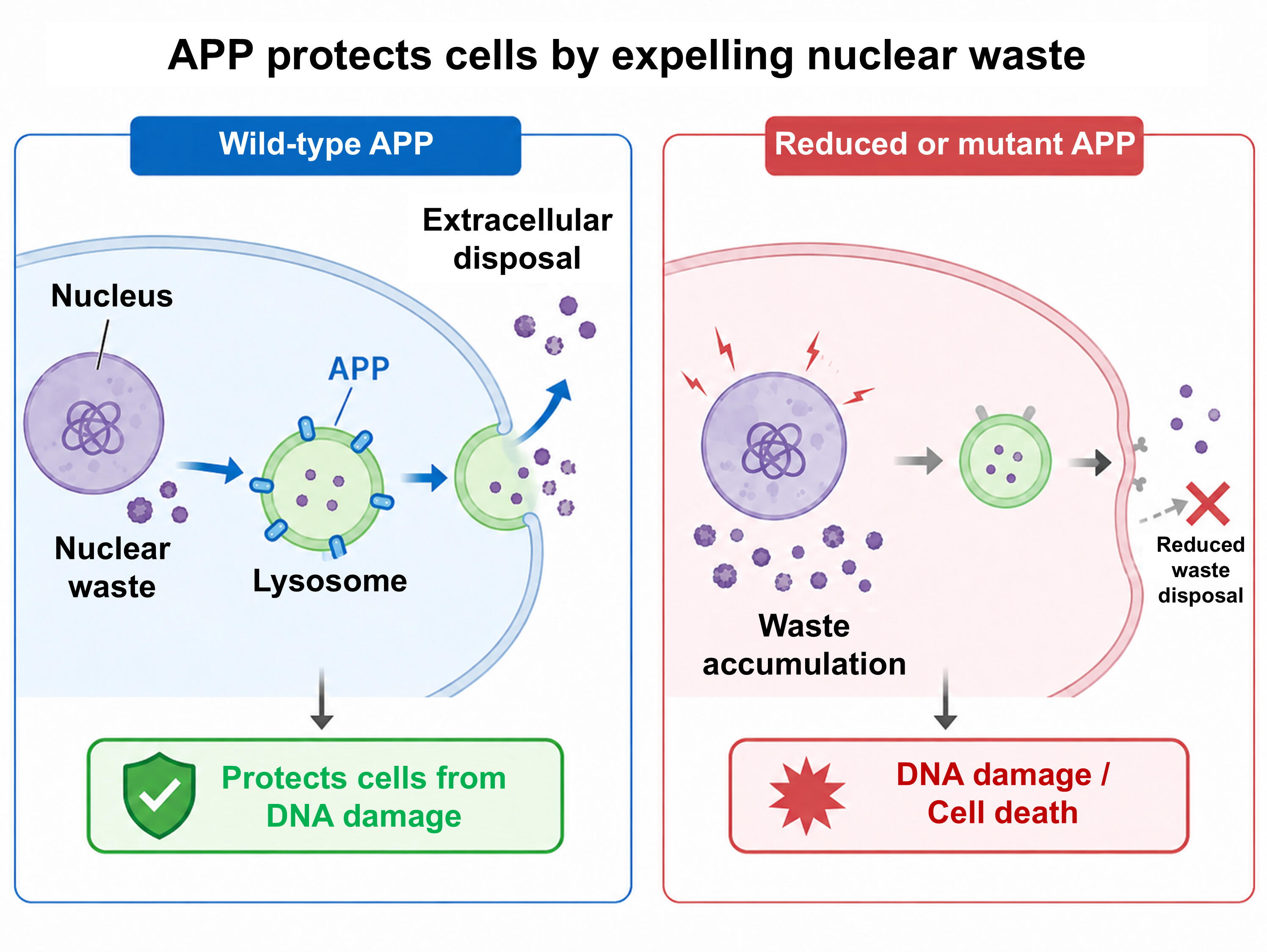
APP promotes nuclear waste clearance via lysosomal exocytosis.
Amyloid precursor protein (APP) co-localizes with nuclear-derived material, including histones and DNA fragments, near lysosome-associated molecules under nuclear damage conditions and promotes the extracellular release of this material via lysosomal exocytosis. Reduced APP function or familial Alzheimer's disease-associated APP mutations impair this clearance, leading to intracellular accumulation of nuclear waste, increased inflammatory signaling, and cell death.Original Publication
"A protective role for APP in nuclear waste clearance via lysosomal exocytosis"
Dougnon G, Otsuka T, Nakamura Y, Sakai A, Yamanaka T, Matsui N, Nakahara A, Ito A, Hatano A, Matsumoto M, Igarashi H, Kakita A, Ueno M, Matsui H.
Proc Natl Acad Sci U S A. 2026 Jun 16;123(24):e2524190123. doi: 10.1073/pnas.2524190123. Epub 2026 Jun 11.
