Research: Neurodegeneration
Why do the mechanisms that protect cells fail?
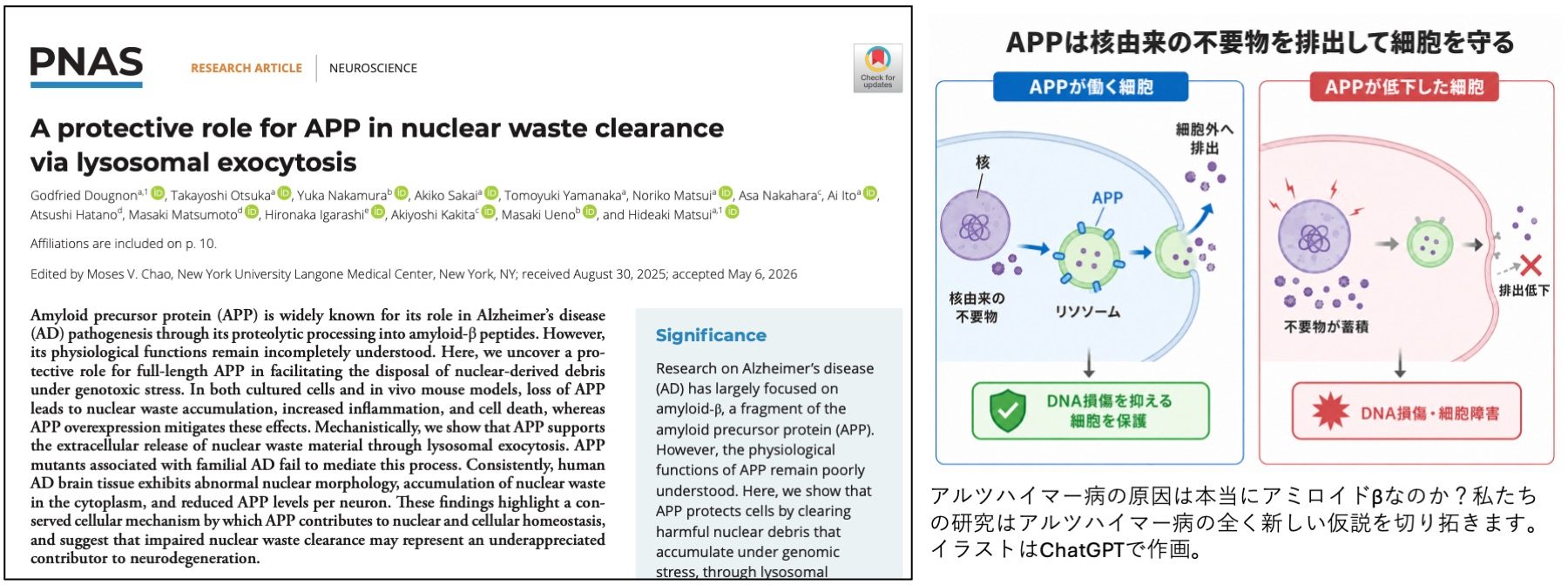
APP, a protein involved in Alzheimer’s disease, is the precursor of amyloid-β. But what does APP itself do inside the cell? In Parkinson’s disease, how do mitochondrial and lysosomal abnormalities connect and injure neurons? We focus on the handling of waste derived from the nucleus and from mitochondria, and ask how protective mechanisms, and their failure, relate to brain disease.
What we found — APP clears “nuclear waste” and protects the cell
We found that APP discharges waste such as DNA and nuclear proteins leaking from a damaged nucleus, and thereby protects the cell. This discharge involves lysosomal exocytosis, in which lysosomes fuse with the plasma membrane and release their contents outside the cell.
In cultured cells and in mouse brain, reducing APP when the nucleus was damaged led to accumulation of nuclear-derived waste and worsened cellular injury. Familial Alzheimer’s variants of APP did not provide the protection seen with ordinary APP. In postmortem brain from patients, we also saw nuclear abnormalities, accumulation of nuclear-derived material, and less APP per neuron.
From this finding, we look at APP not only as the source of amyloid-β, but as a molecule that protects cells from nuclear damage.
Paper: Dougnon et al., Proc. Natl. Acad. Sci. USA, 2026. doi:10.1073/pnas.2524190123 / BRI research summary (Japanese)
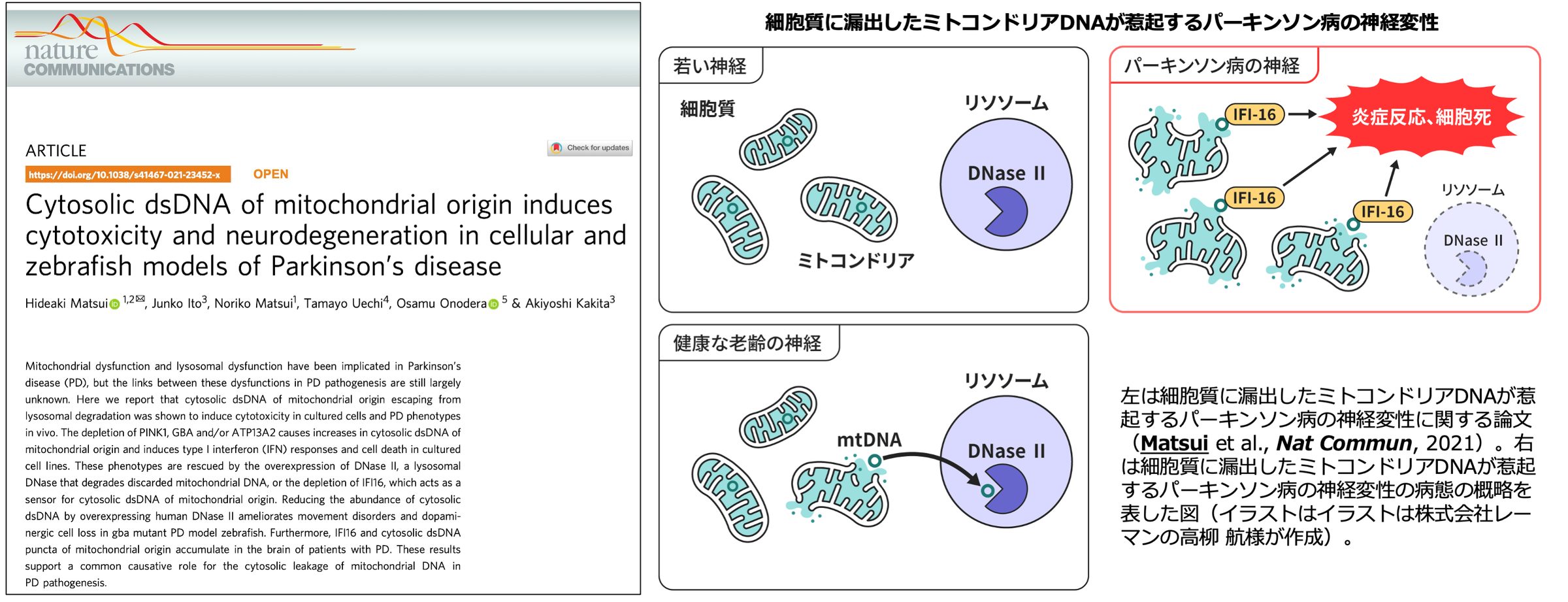
What we found — mitochondrial DNA accumulates in the cytosol
In Nature Communications (2021), we reported that in cell and zebrafish models of Parkinson’s disease, mitochondrial DNA (mtDNA) leaks into the cytosol and accumulates there, contributing to inflammation and neurodegeneration.
In cells, increasing DNase II, an enzyme that degrades DNA, or reducing IFI16, a molecule that senses DNA, suppressed inflammation and cell death. In gba mutant zebrafish, increasing expression of human DNase II improved motor impairment and the loss of dopaminergic neurons. Postmortem brain from people with Parkinson’s disease also showed accumulation of cytosolic mtDNA and IFI16.
Paper: Matsui et al., Nat. Commun., 2021. doi:10.1038/s41467-021-23452-x / Press release (Japanese PDF)
Connecting findings in cells and animals to human disease
Depending on the question, we combine cultured cells, human iPSC-derived neurons, small fishes, mice and human postmortem brain. A strength of the laboratory is that mechanisms found in cells and animals can be set alongside analyses of human disease brain through the institute’s brain bank. Alongside Alzheimer’s disease and Parkinson’s disease, we also work on ALS and multiple system atrophy.
Questions to take forward.
Neurodegeneration
Question What physiological roles do the molecules implicated in brain disease play inside the cell?
What we want to ask next
- How do molecules such as APP, APOE and α-synuclein (SNCA) take part in the mechanisms that protect cells? How do changes or failures in those functions lead to disease?
- Mitochondria were once bacteria. When their DNA leaks into the cytosol, why do neurons sense it as foreign?
Who might start here A starting point if you care about neurodegeneration, including Alzheimer’s disease, Parkinson’s disease and ALS, or about the physiological functions of proteins in cells.
Discuss research opportunities
Projects develop through discussion, starting from the lab’s research strengths and your interests and experience. We value researchers who learn from their results, refine the question and help shape the direction of their work.