Research: Neurodevelopmental disorders
The problem
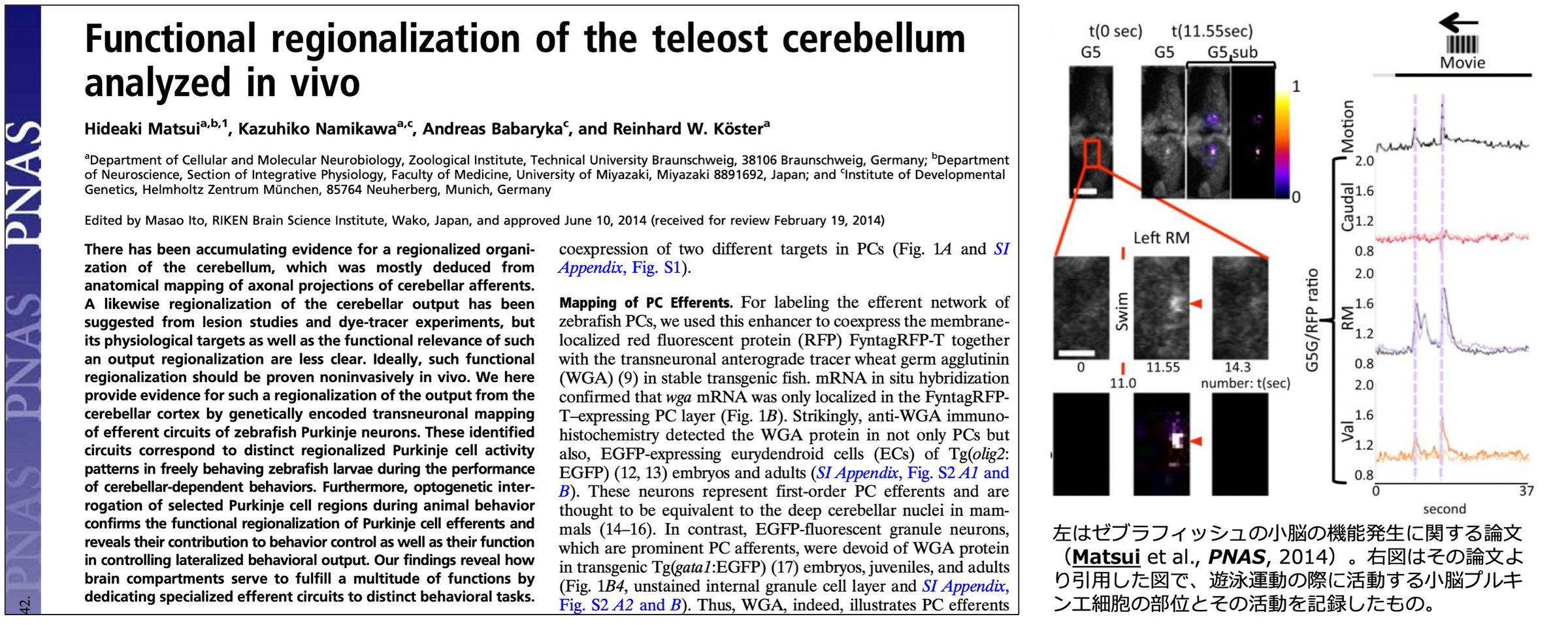
The zebrafish cerebellum lacks the prominent folds of the human cerebellum and appears uniform. Do different regions nevertheless perform different functions? By relating neural connections to activity, we have mapped its functional organization. We also investigate how genes and the environment shape sensory processing and social behaviour, with the aim of understanding neurodevelopmental disorders.
What we found — a functional map of the cerebellum
We mapped the pathways that send information from the zebrafish cerebellum to other brain regions, imaged activity during swimming and nystagmus, and showed that anatomical maps match activity maps. Changing the activity of specific regions with optogenetics changed the corresponding behaviour. The work was published in PNAS in 2014.
Paper: Matsui et al., Proc. Natl. Acad. Sci. USA, 2014. doi:10.1073/pnas.1403105111
What we found — the same mutation, different social behaviour across environments
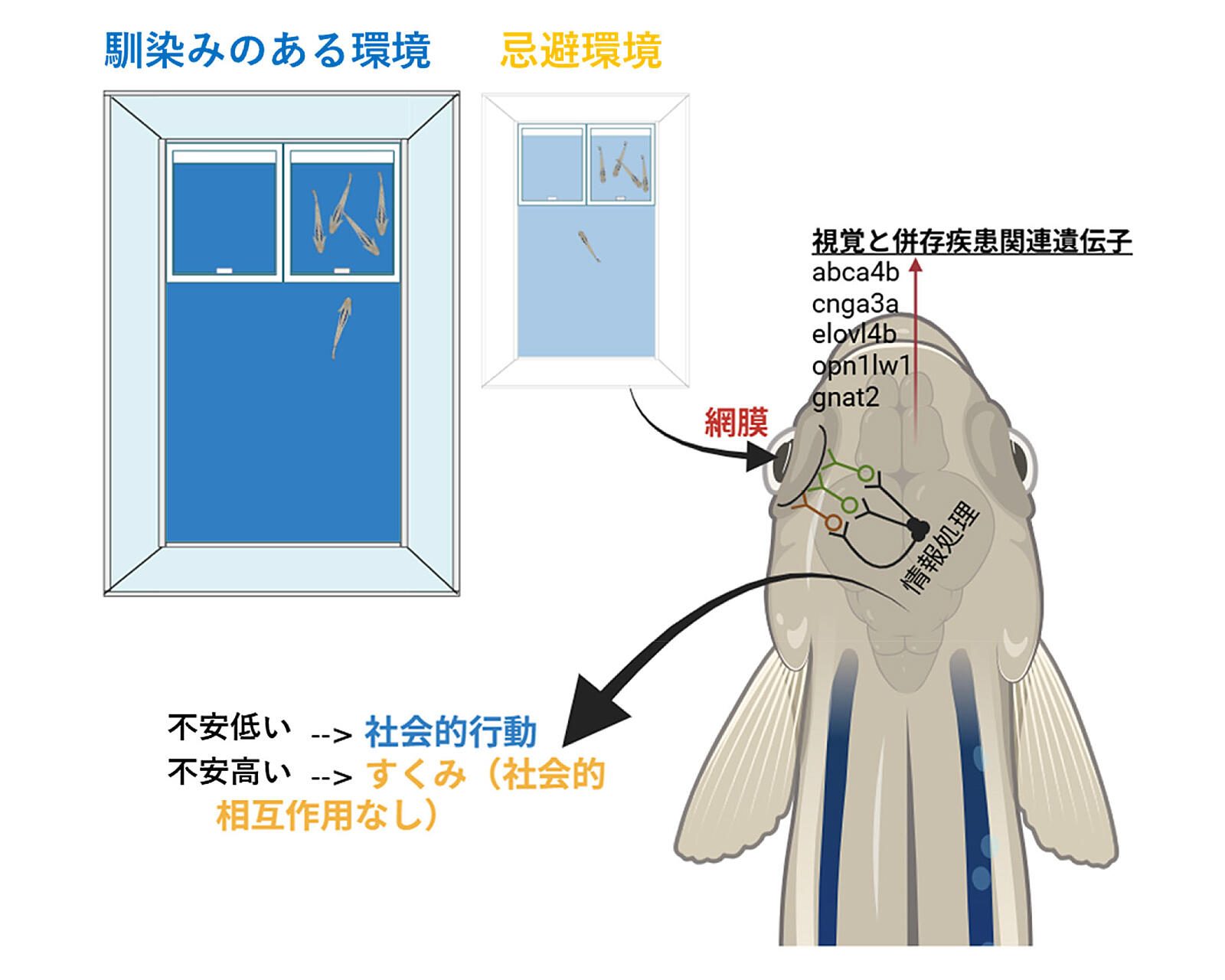
In zebrafish lacking ube3a, the fish counterpart of UBE3A, which is related to Angelman syndrome and autism spectrum disorder (ASD), we asked how social behaviour depends on environment. In an anxiety-inducing white polystyrene tank, mutants stayed away from conspecifics; in a transparent acrylic tank resembling the familiar rearing environment, social behaviour improved. Gene expression and brain-activity mapping pointed to abnormal visual processing and heightened anxiety. Sociability in genetically predisposed individuals can be strongly modified by context (Dougnon and Matsui, Molecular Psychiatry, 2025). doi:10.1038/s41380-025-03180-0 / Press release
Link to human neurodevelopmental disorders
We are testing how cerebellar regions that interact with the cerebrum, in fish and humans, relate to developmental conditions, aiming at a deeper understanding of autism and ADHD.
Questions to take forward.
Neurodevelopmental disorders
Question How do genes and environment shape brain development and behavioural traits?
What we have found Cerebellar output in zebrafish is functionally regionalized (PNAS, 2014). In ube3a mutant fish, social approach falls in an unfamiliar, anxiety-provoking environment and improves in a familiar one (Molecular Psychiatry, 2025).
What we want to ask next
- How does the brain contribute to social behaviour and sensory processing? How can that understanding be connected to environments and support that fit each person?
- Why does sociability change with the environment, even with the same gene mutation?
Approaches We combine behavioural assays in small fishes with calcium imaging and genetic models. Circuit questions are tested with activity mapping or optogenetics; molecular questions connect to gene-expression analysis.
Who might start here A fit if you are interested in developmental disorders, social behaviour, the cerebellum or sensory processing. You can enter through behaviour or through imaging.
- Dougnon, G., Matsui, H.*. Environmental context modulates sociability in ube3a zebrafish mutants via alterations in sensory pathways. Mol. Psychiatry. 2025. doi:10.1038/s41380-025-03180-0
- Matsui, H.*, Namikawa, K., Babaryka, A. and Köster, R. Functional regionalization of the teleost cerebellum analyzed in vivo. Proc. Natl. Acad. Sci. USA. 2014. doi:10.1073/pnas.1403105111
Discuss research opportunities
Projects develop through discussion, starting from the lab’s research strengths and your interests and experience. We value researchers who learn from their results, refine the question and help shape the direction of their work.