Research: Aging and evolution
The problem
We have used medaka and zebrafish to investigate the mechanisms of Parkinson’s disease. Alongside models created by genetic modification or drug treatment, we wanted to understand how brain pathology emerges during aging itself. This led us to the African turquoise killifish, a short-lived fish from seasonal pools in Africa. What happens in the brain of a vertebrate that ages within such a short time, even in the laboratory? We use this question to explore human age-related disease.
What we found
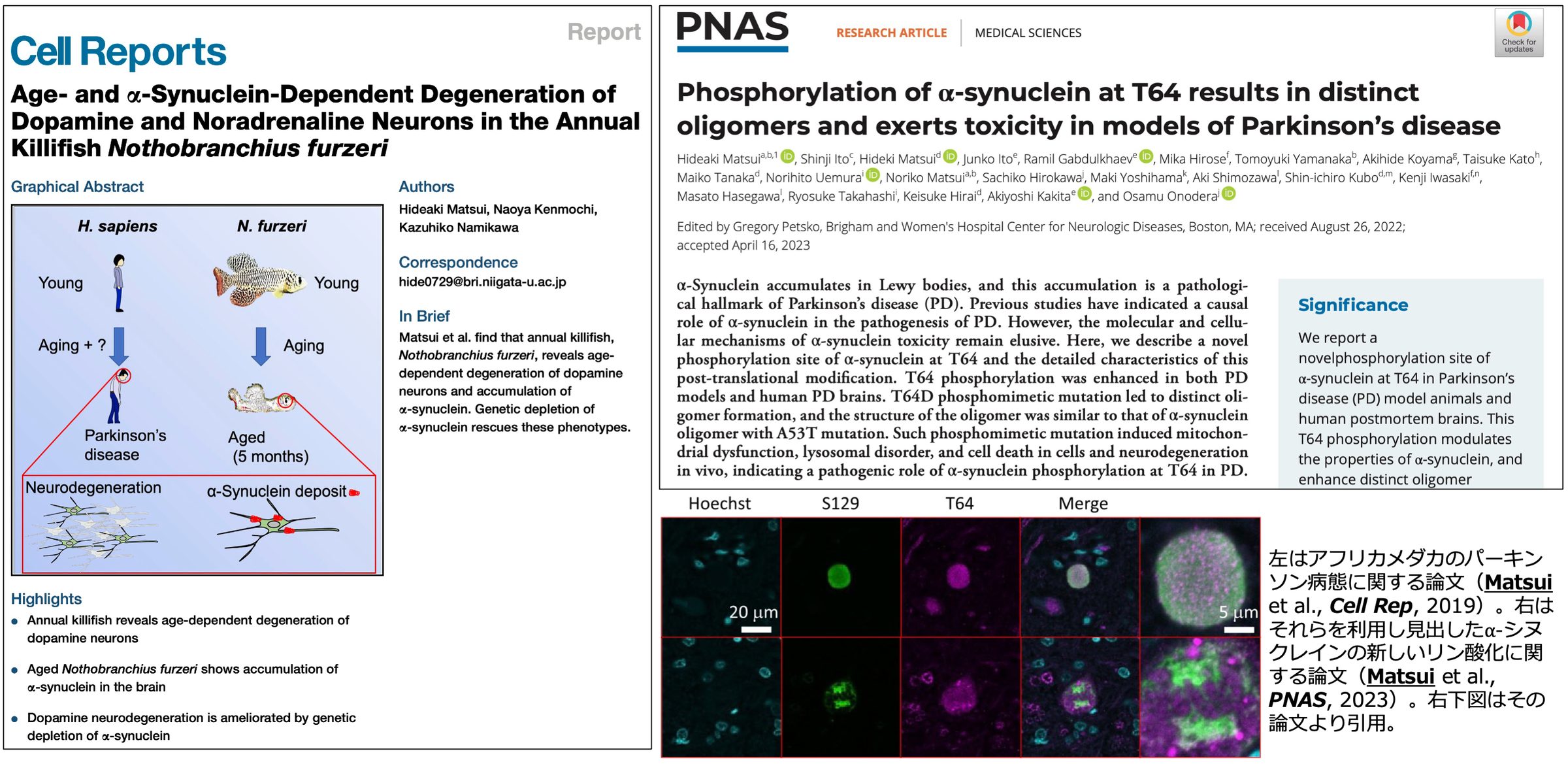
In the African turquoise killifish, we found that aging is accompanied by dopaminergic degeneration and accumulation of α-synuclein. We reported these changes, which resemble human Parkinson’s disease, in Cell Reports in 2019. Analysis of α-synuclein in fish and human brain tissue identified phosphorylation at T64. Further experiments linked this modification to altered oligomer structure and toxicity (PNAS, 2023).
Papers: Matsui et al., Cell Rep., 2019. doi:10.1016/j.celrep.2019.01.015
Matsui et al., Proc. Natl. Acad. Sci. USA, 2023. doi:10.1073/pnas.2214652120 / Press release (Japanese PDF)
Models and the link to human aging
We are pursuing pathology and omics of aging and age-related disease in this killifish, aiming at insights into aging and age-related disease across species, including humans. We were among the first in Japan to breed them stably. Beyond how long or short a life is, we ask which cells, and by what path, move toward disease as the animal ages.
Questions to take forward.
Aging
Question Where does aging end and disease begin?
What we have found With age alone, the turquoise killifish develops dopaminergic degeneration and α-synuclein accumulation (Cell Reports, 2019; PNAS, 2023). Our view is that aging is the base of age-related disease, and that a further vicious cycle is what turns it into disease.
What we want to ask next
- Can we stop disease without stopping aging? And why do we age at all?
Approaches We compare killifish at different ages using histology, omics, imaging and behavioural assays. Zebrafish and cultured cells are used when a mechanism needs to be isolated. With the required approvals, findings from cells and animals are then tested in human tissue.
Who might start here A starting point if you care about aging biology, comparative pathology or omics. Prior fish-husbandry experience is not required.
Evolution
Question What are the evolutionary origins of brain disease, developmental disorders, or aging?
An evolutionary perspective Alpha-synuclein, a protein implicated in Parkinson’s disease, first appeared in fish. Proteins related to amyloid precursor protein (APP), which is implicated in Alzheimer’s disease, are also found in fish and insects. The turquoise killifish develops Parkinson-like pathology during aging (Cell Reports, 2019).
What we want to ask next
- Why have molecules that are also involved in disease been passed down for hundreds of millions of years? How have the diversity of brain function and its vulnerabilities to disease and disability arisen through evolution?
- Wild animals also develop brain disease. How does that persistence relate to what the molecules normally do, and to their evolutionary background?
Approaches We bring together cells, fishes and mice, modern neuropathology and evolutionary methods, and the BRI brain bank.
Who might start here A starting point if you care about evolution, comparative biology, or the origins of disease.
- Matsui, H.*, Kenmochi, N., Namikawa, K. Age- and α-Synuclein-Dependent Degeneration of Dopamine and Noradrenaline Neurons in the Annual Killifish Nothobranchius furzeri. Cell Rep. 2019. doi:10.1016/j.celrep.2019.01.015
Discuss research opportunities
Projects develop through discussion, starting from the lab’s research strengths and your interests and experience. We value researchers who learn from their results, refine the question and help shape the direction of their work.