
Our Aim
Challenges to Elucidate the Molecular Mechanisms
Required to Maintain Appropriate Neural Circuits
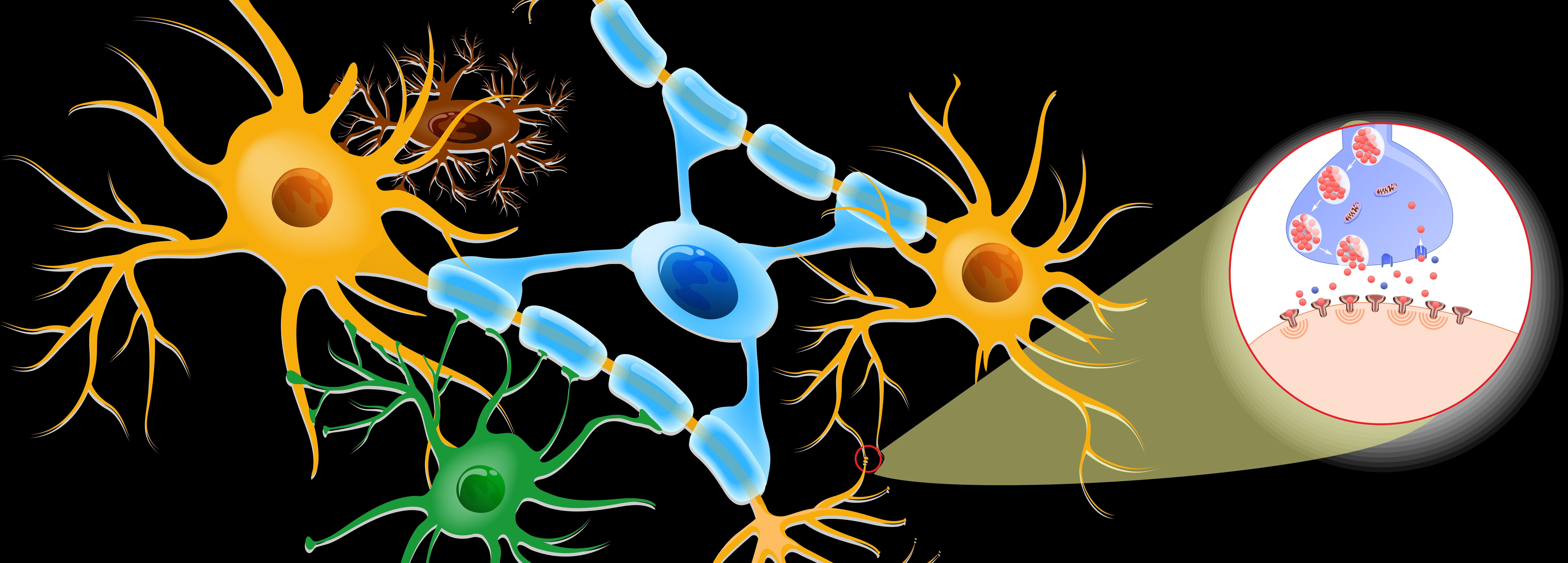
The brain is responsible for learning and memory, and it is intimately linked to the feelings of comfort and discomfort. Neural circuits needed for these functions usually continue to function throughout life, unlike other somatic cells, which maintain healthy tissues by turnover. Therefore, the neurons that make up the circuit have a mechanism to maintain long-term health through unique cell-cell interactions. When it is disrupted by aging, neurodegenerative diseases, and psychiatric disorders, it causes abnormal communication between nerves, resulting in symptoms such as cognitive decline. However, in the aging human population and with neurodegenerative diseases, the breakdown of neural circuits occurs gradually and progresses over an extremely long time period (10 years). Therefore, it takes a long time to observe the mechanism of breakdown of the intercellular communication mechanism that functions to maintain nerve cells. In addition, the neural circuitry is complex verify the interactions between specific cells. Because of these issues, the mechanism of neuronal circuit maintenance by cell-cell interactions is not well understood. Our study addresses this problem from three perspectives using Drosophila, which has a short life cycle and a simple neural circuit (figure).
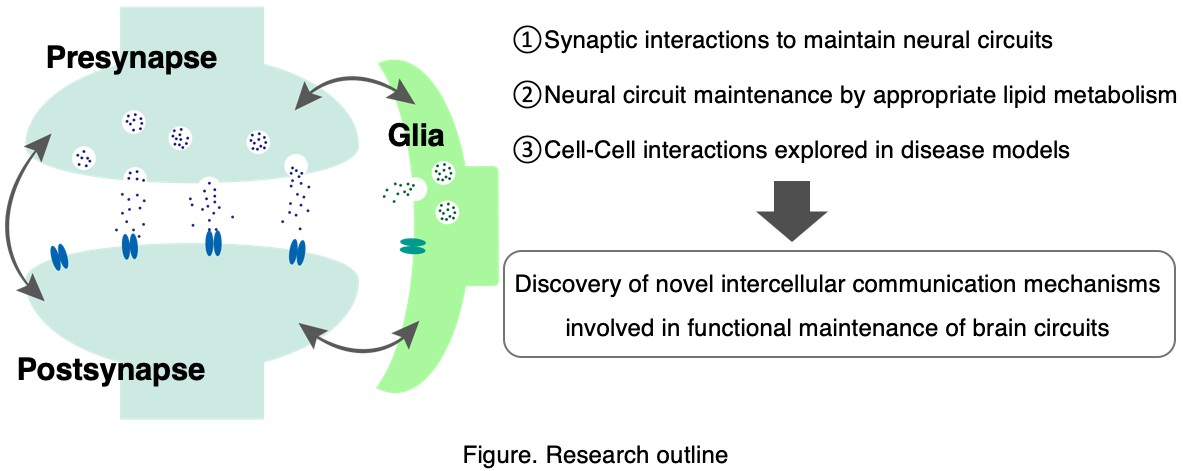
We hope to propose the molecular basis of new neural maintenance mechanism by appropriate regulation of the synapse and lipid metabolism and aim to elucidate the conditions of disorders that occur in the brain circuits of unexplained neurodegenerative diseases and psychiatric disorders. In addition, this research aimed at contributing to medical care by creating neurodegenerative Drosophila models that take advantage of the characteristics of simple model organisms.
Funding
research map
https://researchmap.jp/ghrththe
Challenging Research (Pioneering) (JSPS: KAKENHI) (2017–2019)
Takeda Science Foundation (2018-2021)
Grant-in-Aid for Young Scientists (A) (JSPS: KAKENHI) (2017–2020)
Nagai NS promotion foundation for science of perception (2018-2019)
The Uehara Memorial Foundation (2017-2019)
Narishige Neuroscience Research Foundation (2017)
The Nakabayashi Trust For ALS Research (2017-2018)
Gant-in-Aid for Young Scientist (JSPS: KAKENHI) (2018–2021) (Nitta)
Grant in Aid for JSPS Fellows (JSPS: KAKENHI) (2018-2021) (Nitta)